




Tone Locker
A founder had an idea for how musicians relate to their gear. I helped turn it into a product with a clear identity and a sequenced roadmap.
The idea before the product
This was the first time a founder and I shared the same passions outside of our careers. Both musicians, both collectors. He had a real observation: the way people relate to their instruments has almost nothing to do with buying and selling, but every product in the space treats it like it does.
That observation was sharp. It was not a product yet. My task was to work with the founding team to figure out what solving that problem could look like, in what order it would need to be built, and how it could turn into a product with a plan they could execute against with a bootstrapped budget and a rotating cast of freelance engineers.
I leaned on twenty-five years as a musician to inform these calls, and that was deliberate. It's rare that a designer's life outside of design maps this directly onto the problem space.
What the product is
Reverb and Sweetwater are good at transactions. You show up when you're selling. That's the entire relationship. There was no reason to build another version of that.
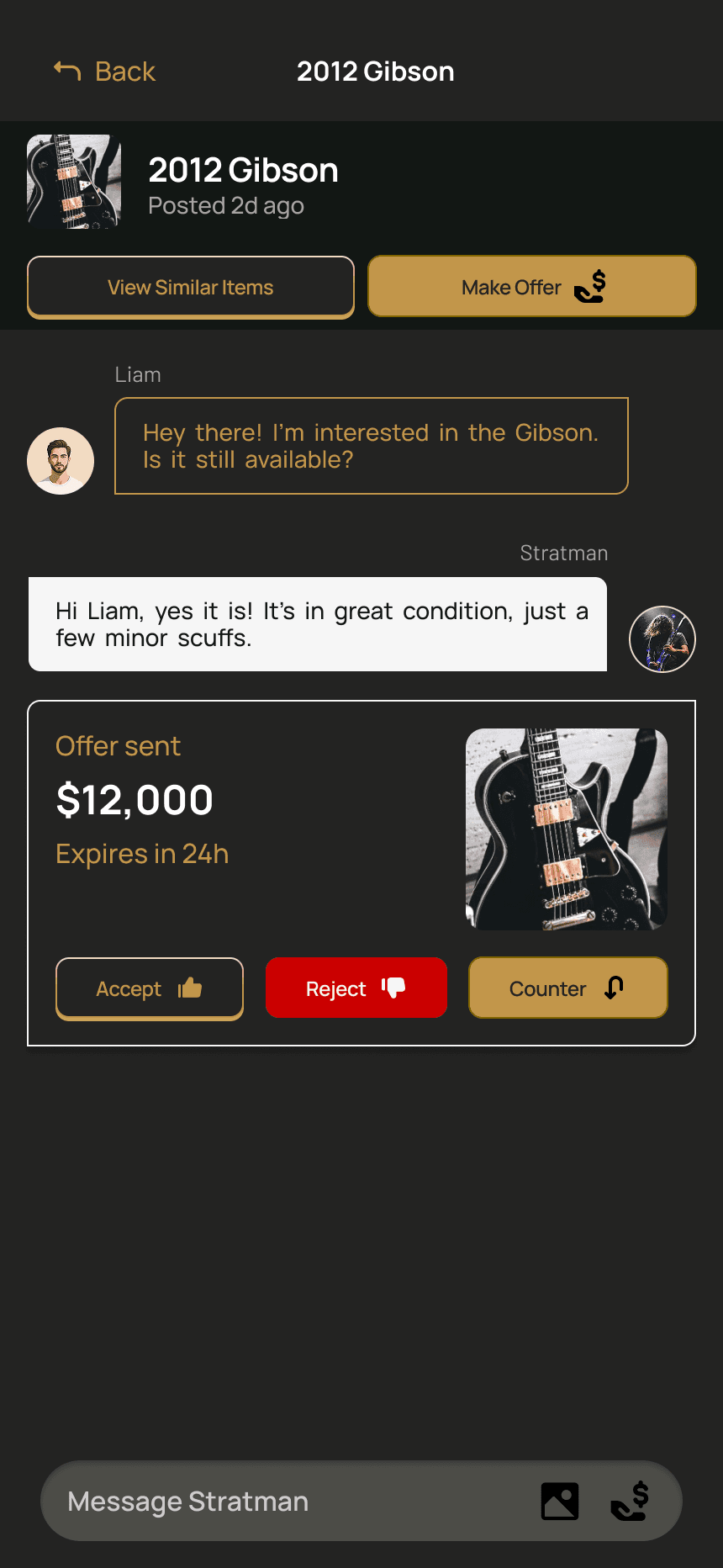
Tone Locker is inventory and community first. A collector's relationship with their gear starts long before they'd ever consider selling it, and the product has to live in that space before it earns the right to facilitate a transaction. Messaging, offers, negotiation all exist in the plan. They come after the identity is established.
How the product needs to feel
Dark, warm, and specific to collectors. The visual system had to feel like the gear itself, not like a marketplace listing page.


The product identity was the scoping decision. What was worth building after that required design.
The cutting room floor
We prototyped a gear practice randomizer and tracker. The idea was solid: lean into the routine musicians already have, gamify it, and use it as a retention lever.
I built out the concept and screens. It worked as a feature, but stood in contrast vs. serving the product. Practice is solitary. Tone Locker's first job was to build a community, and a feature that rewarded spending time alone with your instrument was pulling in the opposite direction. Useful on its own terms, wrong for the sequence.
It got cut. The time went into the social feed and locker builder instead. That's the call a founder is paying for: not whether something is a good idea, but whether it's the right idea right now.
The plan
Identity became structure. Once we knew what Tone Locker is, the roadmap wrote itself in sequence.
The sequencing gave Cameron and a small team a clear picture of what they were building this quarter, what was coming next, and why the order was the order. It also gave me a design roadmap I could work against without waiting for decisions that hadn't been made yet.
The work
I broke the product into four phases, from community through monetization. All four were designed during the same period. What shipped first was a sequencing decision, not a scope limitation.
Two phases are live. One is being built. One is ready for when the business model needs it.
Inventory & Community
ShippedThe product identity. Collectors build a public inventory and share their gear. The social layer connects people over shared obsessions before anyone talks about buying or selling.
Locker builder, social feed, attribute tag system, listing detail, brand system
What shipped, and what happened
The social experience and locker builder shipped in early 2025. Share your gear and build out an inventory in the same motion.
User growth has been nominal, tied to marketing pushes, giveaways, and trade shows. Organic pull hasn't been the driver yet. The app sits at 4.7 stars, and early feedback has been positive. Retention still leans on incentives, which is an honest limitation of where the product is.
Early feedback has been genuinely positive. Users are tracking their collections and excited about what comes next.
Community and messaging shipped. Offers being built. Insurance concept ready for funding conversations. The design artifacts held. The thesis is still open.
The product identity, the sequenced plan, the UX and UI through launch, the brand system, and the go-to-market strategy. I did not write the code.
What I'd change, and what changes when it's yours
More effort on organic-growth research. What makes browsing and community sticky for this audience. That research is what the roadmap should be built on.
On Tone Locker, I had a rare overlap: the designer was also the target user, with twenty-five years of context to pull from. That let us build with conviction before a single user tested or validated anything. It worked because the overlap was real, not because skipping research is a good default.
On your product, that overlap probably doesn't exist, and I wouldn't pretend it does. If a founder comes in light on market research, that research becomes a precondition of the engagement. The instinct that worked here was specific to this project. The process of knowing when you have that instinct and when you don't, that's what transfers.